Peter's electronic projects Peter's electronic projects
Every shot in a film is defined by two primary structural attributes: distance and angle. By manipulating these elements, filmmakers control exactly how the audience perceives a character or situation. Shot Scale and Framing
A key feature of recent updates is the ability to classify shots even when they lack a clear subject, ensuring that environmental or mood-setting shots are analyzed with the same priority as character-focused ones. General Filmmaking Application
In filmmaking, a shot is defined as a continuous strip of motion picture film or digital video footage comprised of a series of frames, running for an uninterrupted period of time. It is the smallest unit of cinematic storytelling. Understanding the mechanics of a shot reveals how filmmakers manipulate time, space, and emotion. 1. Shot Sizes (The Scale of the Subject) movieshot
If you were looking for information on a specific film titled " Article 15
To start your own collection:
: The "long take"—a single, continuous shot without cuts—can immerse the audience in a high-stress environment, making them feel like they are right there in the action. Thematic Depth
#movienight #movieshot #moviereview #nowwatching #filmcommunity #cinephile Option 3: The "Behind the Scenes" Look Every shot in a film is defined by
A , or film shot, is the foundational building block of cinema. In the simplest terms, a shot is a single, uninterrupted piece of film or digital footage captured by a camera between a starting click and a stopping click. While a casual viewer might focus entirely on the dialogue or the actors' faces, it is the deliberate construction of the shot that quietly whispers—or screams—the emotional truth of a scene.
The camera is positioned at the character's eye line. This creates a neutral, objective view that promotes empathy and realism. General Filmmaking Application In filmmaking, a shot is
A solid movieshot creates a specific psychological state for the viewer:
Some movie shots transcend their original stories to become global cultural shorthand. Consider Leonardo DiCaprio raising a glass in The Great Gatsby or Keanu Reeves dodging bullets in The Matrix . These frames are instantly recognizable. They are repurposed daily to communicate complex emotions, humor, and social commentary across the globe. How Technology is Redefining the Frame
 Try it now, before building! Click on the transmitter buttons with the
green
labels
on the left and see how the receiver outputs (K1-K8) change. Change
the number of transmitter or receiver channels. Switch the receiver
output type between latched and momentary.
Try it now, before building! Click on the transmitter buttons with the
green
labels
on the left and see how the receiver outputs (K1-K8) change. Change
the number of transmitter or receiver channels. Switch the receiver
output type between latched and momentary.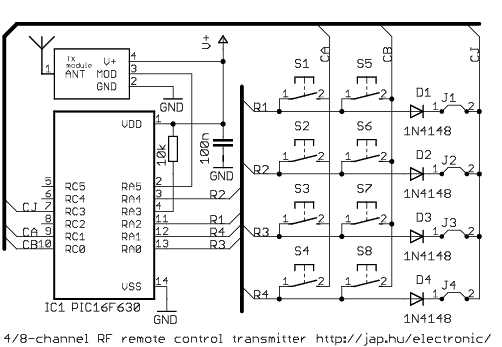
| part | description |
| C1 |
100nF ceramic capacitor |
| R1 |
10k resistor (1/8W) |
| D1-D4 | 1N4148 diode (optional) |
| S1-S8 |
tact switch, DTSM 61N or similar |
| IC1 | PIC16F630 or PIC16F676 microcontroller, pre-programmed |
| TXMOD |
radio
transmitter module, see text (hardware) |
| B1 |
battery between 2-5.5VDC (check TXMOD specs for valid voltage range) |
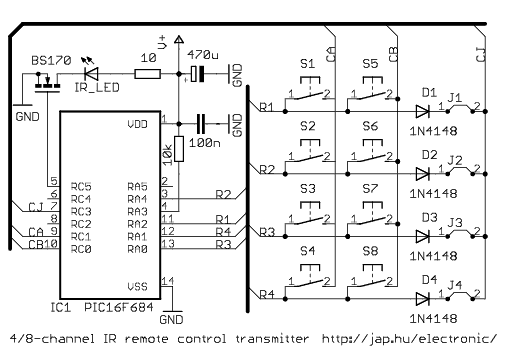
| part | description |
| C1 |
100nF ceramic capacitor |
| C2 |
470 uF 6.3V, electrolytic
capacitor |
| R1 |
10k resistor (1/8W) |
| R2 |
10 ohm resistor (1/4W) |
| D1-D4 | 1N4148 diode (optional) |
| D5 |
IR transmitter LED |
| Q1 |
BSS138 or similar N-MOSFET |
| S1-S8 |
tact switch, DTSM 61N or similar |
| IC1 | PIC16F684 microcontroller, pre-programmed |
| B1 |
battery between 2-5.5VDC (CR2032, 3.6V LiIon battery or 3xAA
batteries) |
| please
observe the corresponding address configuration! |
|
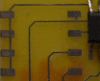 transmitter: no diodes connected |
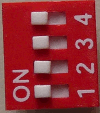 receiver: switches all ON |
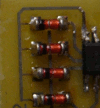 transmitter: all diodes connected |
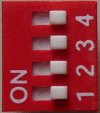 receiver: switches all OFF |
parts list
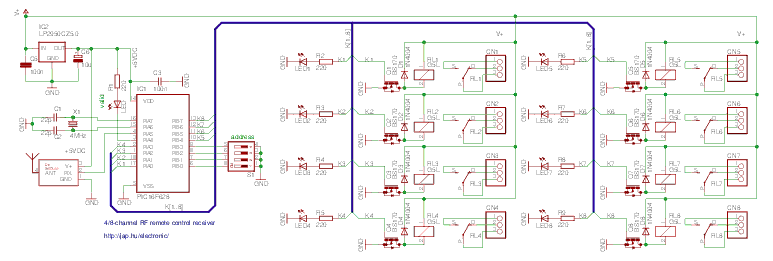
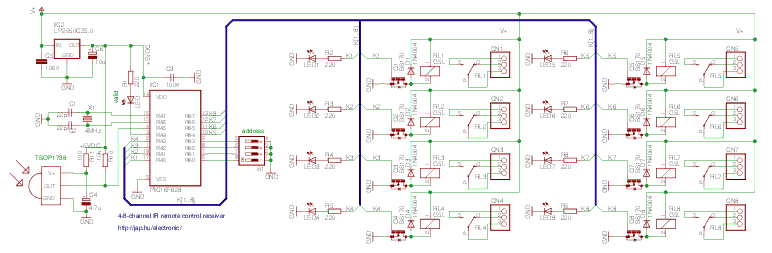
| part | description |
| C1, C2 | 22pF ceramic capacitor |
| C3, C5 | 100nF ceramic capacitor |
| C6 | 10uF 6.3V electrolytic capacitor |
| CN1-CN8 | PCB terminal block, 3-way (DG301) |
| D1-D8 | 1N4004 diode |
| IC1 | PIC16F627 or PIC16F628 or PIC16F627A or PIC16F628A microcontroller, pre-programmed |
| IC2 | LP2950CZ5.0 voltage regulator |
| LED | 3mm LED (green) |
| LED1-LED8 | 3mm LED (red) |
| Q1-Q8 | BS170 N-channel mosfet transistor |
| R1-R9 | 220R resistor (1/8W) |
| RL1-RL8 | G5LE relay, see text for coil voltage selection |
| S1 | piano DIP switch, 4-way |
| X1 | 4MHz HC49 crystal |
| RXMOD | 3-pin radio receiver module, see text (hardware) |
| please
observe the corresponding address configuration! |
|
| transmitter: no diodes connected |
receiver: switches all ON |
| transmitter: all diodes connected |
receiver: switches all OFF |
Every shot in a film is defined by two primary structural attributes: distance and angle. By manipulating these elements, filmmakers control exactly how the audience perceives a character or situation. Shot Scale and Framing
A key feature of recent updates is the ability to classify shots even when they lack a clear subject, ensuring that environmental or mood-setting shots are analyzed with the same priority as character-focused ones. General Filmmaking Application
In filmmaking, a shot is defined as a continuous strip of motion picture film or digital video footage comprised of a series of frames, running for an uninterrupted period of time. It is the smallest unit of cinematic storytelling. Understanding the mechanics of a shot reveals how filmmakers manipulate time, space, and emotion. 1. Shot Sizes (The Scale of the Subject)
If you were looking for information on a specific film titled " Article 15
To start your own collection:
: The "long take"—a single, continuous shot without cuts—can immerse the audience in a high-stress environment, making them feel like they are right there in the action. Thematic Depth
#movienight #movieshot #moviereview #nowwatching #filmcommunity #cinephile Option 3: The "Behind the Scenes" Look
A , or film shot, is the foundational building block of cinema. In the simplest terms, a shot is a single, uninterrupted piece of film or digital footage captured by a camera between a starting click and a stopping click. While a casual viewer might focus entirely on the dialogue or the actors' faces, it is the deliberate construction of the shot that quietly whispers—or screams—the emotional truth of a scene.
The camera is positioned at the character's eye line. This creates a neutral, objective view that promotes empathy and realism.
A solid movieshot creates a specific psychological state for the viewer:
Some movie shots transcend their original stories to become global cultural shorthand. Consider Leonardo DiCaprio raising a glass in The Great Gatsby or Keanu Reeves dodging bullets in The Matrix . These frames are instantly recognizable. They are repurposed daily to communicate complex emotions, humor, and social commentary across the globe. How Technology is Redefining the Frame
LATCH_MASK EQU B'00001111' sets channels 8-5 to momentary
and
channels 4-1 to latched (toggle) mode. Then use the compiler (MPLAB or
gputils) to
assemble the code.clrf
0x91 ;
ANSEL